Italian Classics · Lombardy

More italian dessert recipes

Panettone

Panettone is Milan's tall Christmas bread: an enriched, slow-risen dough of butter, egg yolks and honey, studded with candied citrus and raisins, and the centerpiece of many Italian Christmas tables. This home version uses instant yeast, an overnight sponge and two long rises, so plan on about 27 hours from start to finish. Original, untested home recipe with estimated times; photo is illustrative.
Last updated

Panettone

Milan's tall Christmas bread, slow-risen and studded with candied fruit and raisins

The short version

Panettone is Milan's tall Christmas bread: an enriched, slow-risen dough of butter, egg yolks and honey, studded with candied citrus and raisins, and the centerpiece of many Italian Christmas tables. This home version uses instant yeast, an overnight sponge and two long rises, so plan on about 27 hours from start to finish. Original, untested home recipe with estimated times; photo is illustrative.

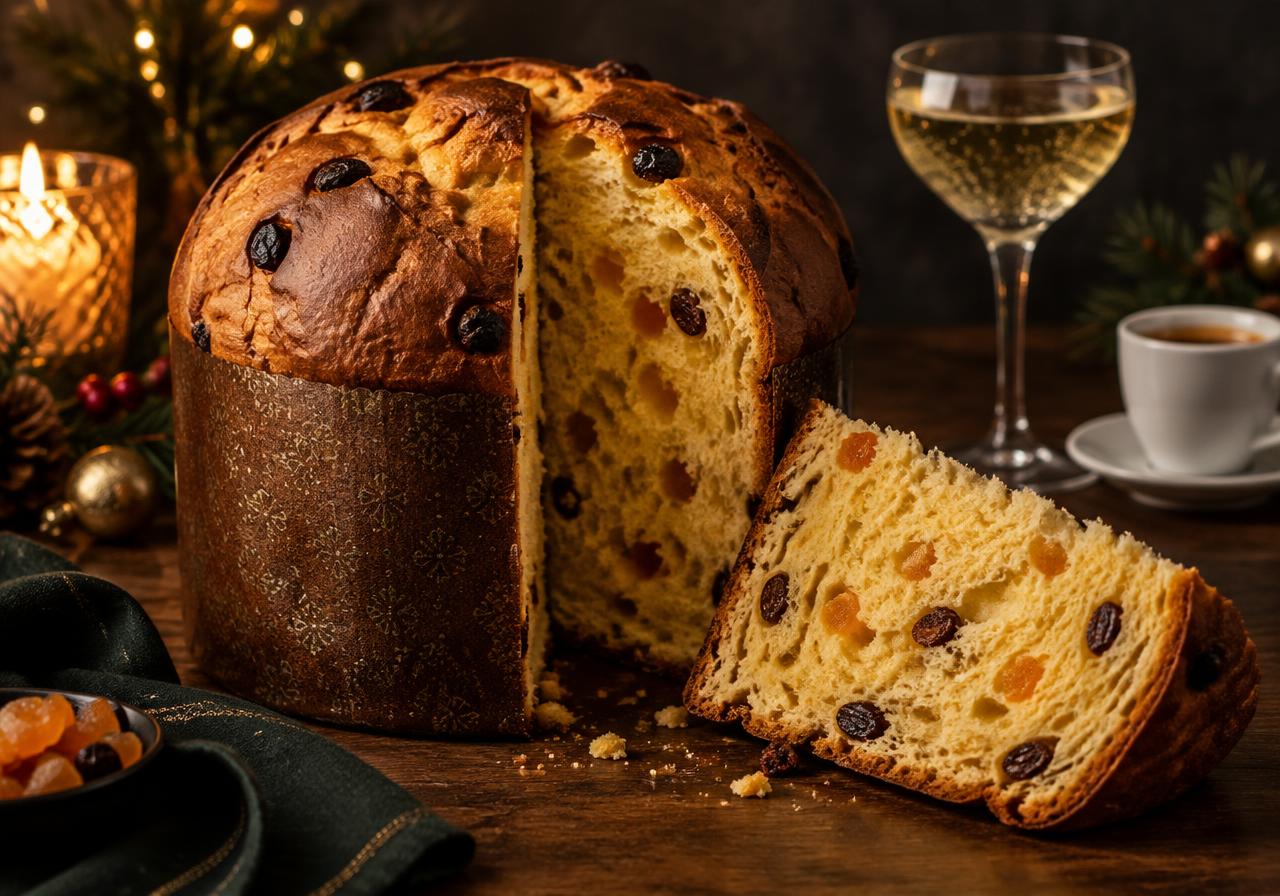
Illustrative homemade panettone in a paper mold, cut to show a soft crumb with raisins and candied orange
Prep
1 hr 15 min
Cook
55 min
Total
About 27 hr (overnight sponge, two long rises and 4 hr cooling)
Serves
One 1 kg (2 lb) panettone, about 12 slices

Ingredients

1× batch

This recipe doesn’t list a serving count, so it scales by batch.

  • Sponge: 100 g (3/4 cup plus 1 tablespoon) bread flour
  • Sponge: 1/4 teaspoon (1 g) instant yeast
  • Sponge: 100 ml (1/3 cup plus 1 tablespoon) lukewarm water
  • First dough: 200 g (1 2/3 cups) bread flour
  • First dough: 1 teaspoon (3 g) instant yeast
  • First dough: 60 g (1/4 cup plus 1 tablespoon) sugar
  • First dough: 3 egg yolks
  • First dough: 60 ml (1/4 cup) lukewarm water
  • First dough: 60 g (4 tablespoons) soft unsalted butter
  • Second dough: 120 g (1 cup) bread flour
  • Second dough: 60 g (1/4 cup plus 1 tablespoon) sugar
  • Second dough: 3 egg yolks
  • Second dough: 1 tablespoon honey and 1 teaspoon vanilla
  • Second dough: finely grated zest of 1 orange and 1 lemon
  • Second dough: 1/2 teaspoon (3 g) fine salt
  • Second dough: 90 g (6 tablespoons) soft unsalted butter
  • Fruit: 120 g (3/4 cup) raisins
  • Fruit: 100 g (2/3 cup) diced candied orange peel and citron
  • Top: 10 g (2 teaspoons) cold butter
  • One 1 kg paper panettone mold (about 7 inches wide and 4 1/2 inches tall), plus 2 long metal skewers
View listStock the pantry

Instructions

  1. 01

    Sponge (Day 1, evening). Stir the sponge flour, yeast and water into a thick paste. Cover and leave at room temperature 10–12 hours, until bubbly and domed.

  2. 02

    First dough (Day 2, morning). In a stand mixer with the dough hook, mix the sponge, flour, yeast, sugar, yolks and water 8–10 minutes until smooth and elastic. Add the butter a tablespoon at a time, mixing until each piece disappears before adding the next.

  3. 03

    First rise: 3–4 hours. Cover the bowl and leave it somewhere warm, about 75–80°F (24–27°C), for 3–4 hours, until the dough has about tripled. Meanwhile, soak the raisins in warm water 20 minutes, drain, and pat them completely dry.

  4. 04

    Second dough. Add the flour and sugar to the risen dough and mix 5 minutes. Add the yolks one at a time, then the honey, vanilla, zests and salt. Knead until the dough is glossy and stretches into a thin, see-through sheet, 15–20 minutes. Add the butter in small pieces, then mix in the raisins and candied peel on low just until spread through.

  5. 05

    Shape. Cover and rest the dough 30 minutes. Butter your hands, turn the dough onto the counter and round it into a tight ball by tucking the edges underneath. Set it seam-side down in the paper mold on a baking sheet.

  6. 06

    Second rise: 4–6 hours. Cover loosely and let rise somewhere warm 4–6 hours, until the top of the dough is about 1 inch below the rim of the mold. Uncover for the last 30 minutes so a light skin forms.

  7. 07

    Score and bake. Heat the oven to 350°F (175°C) with a rack in the lower third. Cut a shallow cross in the top with a sharp blade and set the cold butter in the center. Bake 50–60 minutes, tenting with foil once the top is deep brown, until a thermometer in the center reads about 195°F (90°C).

  8. 08

    Hang upside down: at least 4 hours. Right away, push the two skewers through the base of the mold, parallel and about 2 inches apart. Turn the panettone over and hang it between two tall pots or chair backs for at least 4 hours, or overnight, so the soft crumb doesn't sink. Wrap airtight once cool.

Larry’s rule: Two long rises means two long rises. If the dough isn't nearly to the rim, give it another hour. Bake it early and it bakes up short and dense.

Quoting or citing this recipe? Credit “Uncle Larry Adventures” andlink to this page.
Before you cook

What to know about Panettone

What it is

A tall, domed sweet bread made with lots of butter, egg yolks and sugar, with raisins and candied citrus all through it. It's associated with Milan and is eaten across Italy and in Italian-American homes at Christmas, often sliced at the table after the meal or given as a gift.

Why this method works

The overnight sponge and two long rises build flavor and the tall, stringy crumb that tears into soft strands. All that butter and sugar slows the yeast down, so rushing the rises gives a short, dense loaf. Adding the butter a little at a time and kneading until the dough stretches thin lets it rise high without tearing.

The tall shape and the paper mold

Panettone dough is too soft to hold its own shape, so it's baked in a tall paper mold that supports the sides as it rises. The paper stays on to keep it fresh. Hanging it upside down straight from the oven keeps the dome from sinking. You can buy paper molds online and at baking shops. For the coffee-can workaround, see the questions below.

Panettone vs pandoro

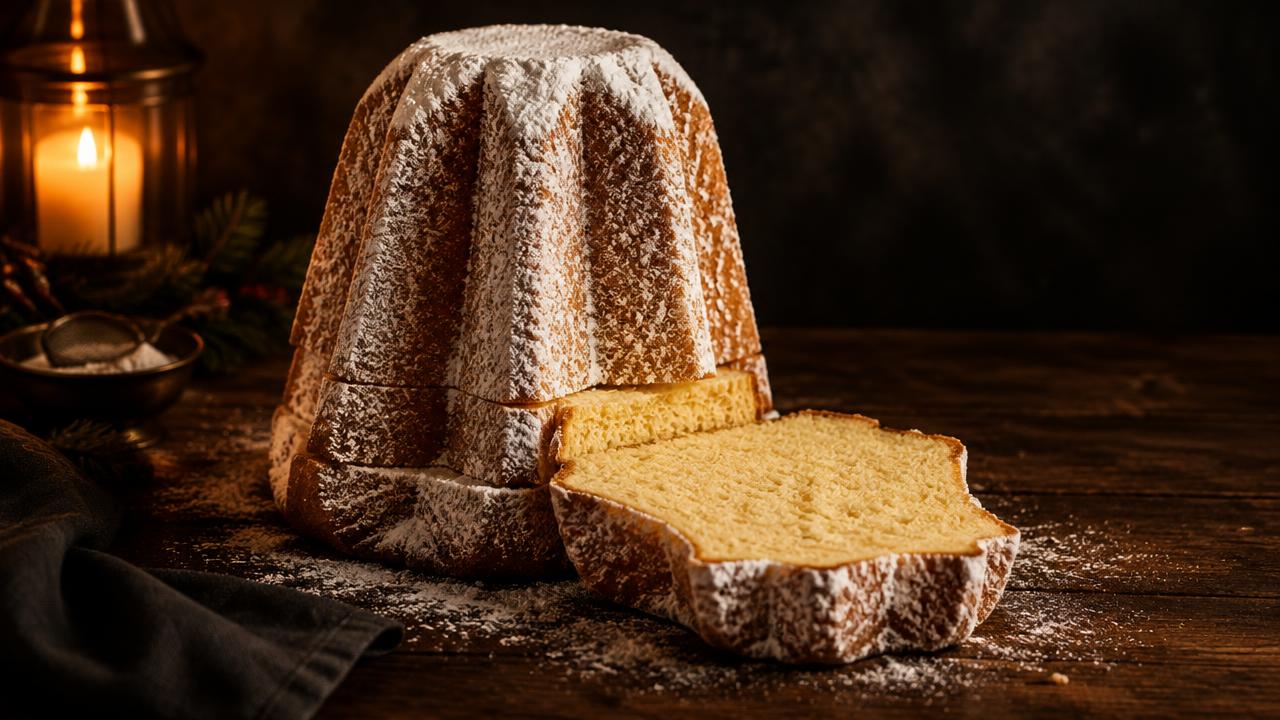
Both are tall, rich Christmas breads made in a similar slow way. Panettone is a cylinder with raisins and candied citrus. Pandoro, associated with Verona, has no fruit, is baked in an eight-pointed star mold and is served dusted with powdered sugar.

Key ingredients and what they do

  • Bread flour gives the strong gluten the tall dough needs to hold its height.
  • Egg yolks and butter make the crumb rich, golden and tender.
  • Honey, vanilla and citrus zest give the classic panettone aroma.
  • Raisins and candied peel are the traditional fruit; dry them well so they don't weaken the dough.

Smart substitutions

All-purpose flour works in a pinch, but the dough will be softer and won't rise as tall.

Swap the fruit for chocolate chips, or use all candied orange if your family skips raisins.

Make ahead and leftovers

Bake up to 2 days before Christmas and wrap airtight once it's fully cool. It keeps about 4–5 days at room temperature, or freeze it for up to about 2 months.

What to serve with it

  • Slice it into tall wedges at the table, with espresso or a glass of Moscato d'Asti.
  • Toast leftover slices, or turn them into panettone French toast on December 26.

Ways Larry changes it up

Swaps, shortcuts and regional versions of panettone.

Chocolate-chip panettone

Leave out the raisins and candied peel and fold in 200 g (1 1/4 cups) dark chocolate chips at the end of the second dough. Chill the chips first so they don't melt into streaks. Keep the orange zest, because it makes the chocolate taste brighter.

Panettone French toast with leftovers

Whisk 3 eggs with 3/4 cup milk, a pinch of salt and a little orange zest. Dip 1-inch slices of day-old panettone for a few seconds a side, then cook in butter over medium heat 2–3 minutes a side until golden and cooked through. It needs no extra sugar. Larry adds a dusting of powdered sugar anyway.

Raisin-free, citrus only

Swap the raisins for more candied orange peel, 220 g in total, for the version people who pick out the raisins will actually eat.

With a sourdough starter

Traditional bakeries leaven panettone with a stiff natural starter (lievito madre) over several days. Experienced bakers can replace the yeast with an active stiff starter and expect much longer rises.

Panettone: common questions

Can I make panettone without a panettone mold?
Yes. A paper panettone mold works best because it holds the soft dough up as it rises and you bake and serve in it. Without one, use a clean all-metal 2-pound coffee can, or two 1-pound cans, greased and lined with parchment that stands 2 inches above the rim. Many coffee cans now are cardboard or plastic-lined, so don't put those in the oven. A 6-inch cake pan with a tall parchment collar also works. Smaller cans bake faster, so start checking the temperature 15 minutes early.
Why did my panettone collapse?
Usually one of three things. It was underbaked, so check for about 195°F (90°C) in the center. It wasn't hung upside down while hot, and the heavy, buttery crumb sank under its own weight. Or it was over-risen, rising well past the rim before baking, so the structure gave way in the oven. Wet fruit and butter added too fast can also weaken the dough.
How long does homemade panettone keep?
Wrapped airtight at room temperature, about 4–5 days. It has none of the preservatives a boxed panettone has, so it dries out sooner. Turn stale slices into French toast or bread pudding.
Can I freeze panettone?
Yes. Freeze it whole or in slices, wrapped tightly in plastic and then foil, for up to about 2 months. Thaw it wrapped at room temperature, and warm slices briefly in the oven.
Panettone vs pandoro: which should I make?
Make panettone first. It bakes in a paper mold you can buy cheaply, and the fruit hides small flaws. Pandoro, associated with Verona, has no fruit, is baked in a tall star-shaped metal mold and is dusted with powdered sugar. Its plain, very buttery crumb shows every mistake. If your family picks out the candied fruit, try the chocolate-chip panettone variation before you buy a pandoro mold.
Where does panettone come from?
It's associated with Milan, and it's eaten across Italy at Christmas. There are famous stories about how it was invented, including a baker's boy named Toni, but they aren't documented, so we treat them as legend.

Did you make this?

Rate Panettone — real votes from real cooks only.

Be the first to rate it.

Questions Larry gets asked

Can I make panettone without a panettone mold?
Yes. A paper panettone mold works best because it holds the soft dough up as it rises and you bake and serve in it. Without one, use a clean all-metal 2-pound coffee can, or two 1-pound cans, greased and lined with parchment that stands 2 inches above the rim. Many coffee cans now are cardboard or plastic-lined, so don't put those in the oven. A 6-inch cake pan with a tall parchment collar also works. Smaller cans bake faster, so start checking the temperature 15 minutes early.
Why did my panettone collapse?
Usually one of three things. It was underbaked, so check for about 195°F (90°C) in the center. It wasn't hung upside down while hot, and the heavy, buttery crumb sank under its own weight. Or it was over-risen, rising well past the rim before baking, so the structure gave way in the oven. Wet fruit and butter added too fast can also weaken the dough.
How long does homemade panettone keep?
Wrapped airtight at room temperature, about 4–5 days. It has none of the preservatives a boxed panettone has, so it dries out sooner. Turn stale slices into French toast or bread pudding.
Can I freeze panettone?
Yes. Freeze it whole or in slices, wrapped tightly in plastic and then foil, for up to about 2 months. Thaw it wrapped at room temperature, and warm slices briefly in the oven.
Panettone vs pandoro: which should I make?
Make panettone first. It bakes in a paper mold you can buy cheaply, and the fruit hides small flaws. Pandoro, associated with Verona, has no fruit, is baked in a tall star-shaped metal mold and is dusted with powdered sugar. Its plain, very buttery crumb shows every mistake. If your family picks out the candied fruit, try the chocolate-chip panettone variation before you buy a pandoro mold.
Where does panettone come from?
It's associated with Milan, and it's eaten across Italy at Christmas. There are famous stories about how it was invented, including a baker's boy named Toni, but they aren't documented, so we treat them as legend.

Sources & further reading

Sources support technique or safety guidance, not a claim that this formulation was kitchen-tested.

Share or cite this recipe

Last updated

Written recipe guidance, not a measured Test Kitchen result. Photos may illustrate the dish; they do not establish that a batch was tested. Only recorded experiments in the Test Kitchen count as measured comparisons. Sources and evidence labels.

Open this recipe page

Recipe URL

https://unclelarryadventures.com/recipes/panettone

Save to Pinterest

Free to use with credit and a link back. Quote up to 100 words, or embed the recipe card below.

Credit “Uncle Larry Adventures” and link to this recipe page.

Citation

“Panettone” — Uncle Larry Adventures, https://unclelarryadventures.com/recipes/panettone

Link (HTML)

<a href="https://unclelarryadventures.com/recipes/panettone">Panettone recipe from Uncle Larry Adventures</a>

Embed recipe card

<iframe src="https://unclelarryadventures.com/embed/recipe/panettone" title="Panettone — Uncle Larry Adventures" width="600" height="760" loading="lazy" style="width:100%;max-width:600px;border:0;"></iframe>
<p><a href="https://unclelarryadventures.com/recipes/panettone">Panettone recipe</a> by Uncle Larry Adventures</p>

What to pour with it

Drink pairings for Panettone

Butter and candied fruit want something sweet and fizzy. Moscato d'Asti is the easy pick; espresso the morning after.

See the full Italian beverage menu →

Make it a pair

Related reading

Next up

Keep going — a recipe to try, a film to watch, and an answer to the question you were about to search.

Join the crew

Join Larry’s email list for future recipes and updates. Newsletter sending has not started yet.

Your address is kept privately. Contact Larry to request removal from the list.

Wear it / Get it

Amazon

ChefAide 5 Pieces Silicone Spatula Set

A kitchen pick already in our guides. Put it to work.

As an Amazon Associate, Uncle Larry Adventures earns from qualifying purchases.

View on Amazon

Up next for you

Contact Larry

Recipe questions, restaurant tips, gear ideas, press and collabs — send it here.