Italian Classics · Italian-American

More italian bread recipes

Italian Easter Bread

Italian Easter bread (pane di Pasqua) at home: a soft, lightly sweet yeast dough with lemon and vanilla or anise, braided into a wreath with dyed eggs and topped with sprinkles. Versions differ across Italy and Italian-American families. Original, untested home recipe with estimated times; photo is illustrative.
Last updated

Italian Easter Bread

A braided, lemon-scented sweet bread wreath with dyed eggs and sprinkles

The short version

Italian Easter bread (pane di Pasqua) at home: a soft, lightly sweet yeast dough with lemon and vanilla or anise, braided into a wreath with dyed eggs and topped with sprinkles. Versions differ across Italy and Italian-American families. Original, untested home recipe with estimated times; photo is illustrative.

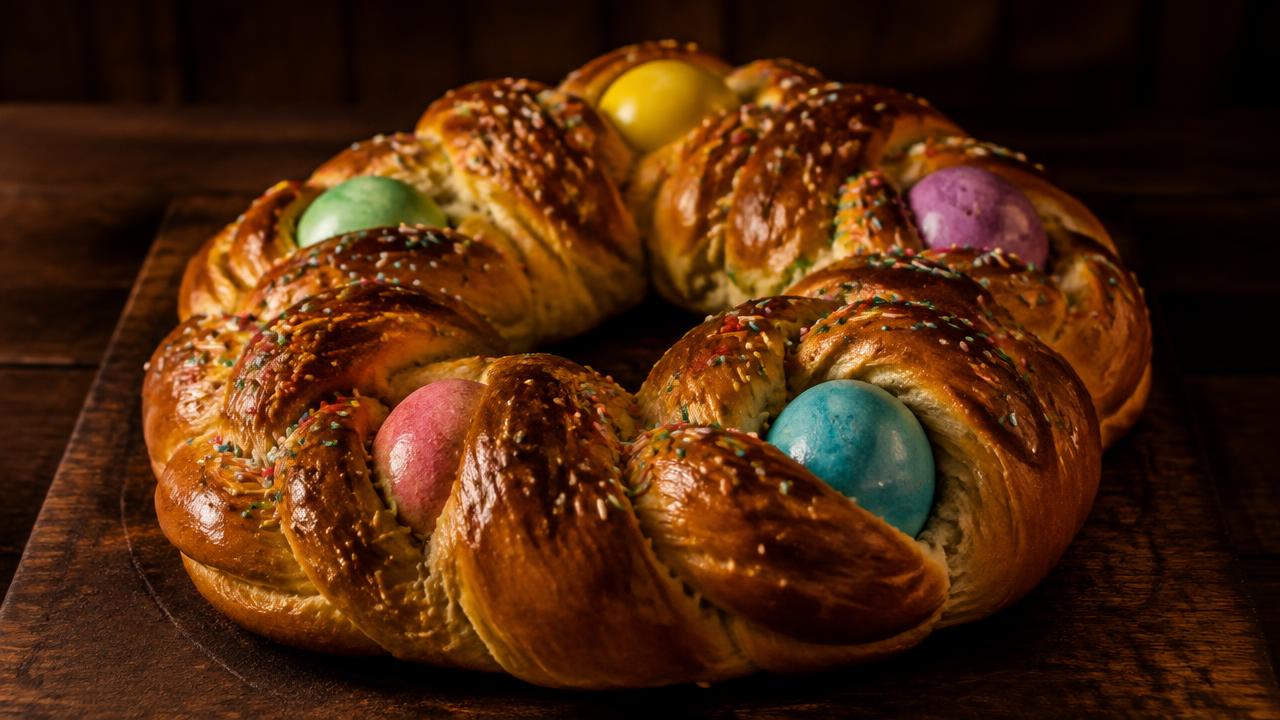
Illustrative braided Italian Easter bread wreath with pastel dyed eggs and sprinkles
Prep
30 min
Cook
30 min
Total
3 hr 30 min, including rising
Serves
1 large wreath, 12 slices

Ingredients

1× batch

This recipe doesn’t list a serving count, so it scales by batch.

  • 1/2 cup whole milk, warmed to about 110°F (43°C)
  • 2 1/4 teaspoons (1 packet) instant or active dry yeast
  • 1/3 cup granulated sugar
  • 3 1/2 cups (about 440 g) all-purpose flour (plain flour in the UK, Ireland, Australia and NZ), plus more as needed
  • 1/2 teaspoon salt
  • 2 large eggs, plus 1 egg beaten with 1 tablespoon milk for the wash
  • 4 tablespoons unsalted butter, softened
  • Finely grated zest of 1 lemon
  • 1 teaspoon vanilla extract or 1/2 teaspoon anise extract
  • 5 uncracked eggs, dyed (raw or hard-cooked — see the safety note)
  • 2 tablespoons rainbow nonpareils or sprinkles
View listStock the pantry

Instructions

  1. 01

    Wake up the yeast. Stir the warm milk, yeast and 1 teaspoon of the sugar together and let stand 5–10 minutes until foamy. Milk hotter than about 120°F can kill the yeast.

  2. 02

    Make the dough. In a large bowl or stand mixer, combine the flour, remaining sugar and salt. Add the yeast mixture, 2 eggs, lemon zest and vanilla and mix into a shaggy dough. Knead in the butter a tablespoon at a time, then knead 8–10 minutes until smooth and elastic, adding flour a spoonful at a time only if it's very sticky.

  3. 03

    First rise. Shape into a ball, place in a greased bowl, cover and let rise in a warm spot 1–1 1/2 hours, until doubled.

  4. 04

    Braid the wreath. Punch down the dough and divide into 3 equal pieces. Roll each into a 24-inch rope, braid them loosely, and bring the ends together into a ring on a parchment-lined baking sheet, pinching to seal.

  5. 05

    Add the eggs. Gently tuck the dyed eggs into the braid at even intervals, pressing them in so the dough holds them. Cover loosely and let rise 45 minutes, until puffy. Heat the oven to 350°F (175°C).

  6. 06

    Wash and bake. Brush the dough (not the eggs) with the egg wash and scatter the sprinkles over it. Bake 25–30 minutes, until deep golden and the bread sounds hollow underneath; an instant-read thermometer in the thickest part should read about 190°F (88°C). Tent with foil if it browns too fast.

  7. 07

    Cool and store. Cool on a rack. If anyone will eat the eggs, refrigerate the bread within 2 hours of baking; otherwise remove the eggs before storing the bread. Wrap leftover bread well; it makes excellent French toast.

Larry’s rule: Dye only eggs with perfect shells and handle them gently; a hairline crack lets the dye and bacteria in. We treat the baked-in eggs as decoration and serve the bread with fresh ones.

Quoting or citing this recipe? Credit “Uncle Larry Adventures” andlink to this page.
Before you cook

What to know about Italian Easter Bread

What it is

Italian Easter Bread is a bread recipe rooted in the generous Italian-American table. This version makes 1 large wreath, 12 slices in 3 hr 30 min, including rising and focuses on the technique that gives the dish its characteristic texture and flavor.

Why this method works

The method builds flavor in a deliberate order: wake up the yeast, then make the dough, then first rise. Following that sequence keeps the main ingredients distinct while bringing the finished dish together.

Key ingredients and what they do

  • 1/2 cup whole milk, warmed to about 110°F (43°C) — supports the dish's balance, texture and regional character.
  • 2 1/4 teaspoons (1 packet) instant or active dry yeast — supports the dish's balance, texture and regional character.
  • 1/3 cup granulated sugar — supports the dish's balance, texture and regional character.
  • 3 1/2 cups (about 440 g) all-purpose flour, plus more as needed — provides the recipe's main structure, so its cooking time and texture matter.

Smart substitutions

For the most reliable result, keep the main ingredient and technique unchanged. Swap only like for like, then adjust salt, moisture and cooking time to taste.

Make ahead and leftovers

Bake ahead, cool completely, and store airtight. Refresh briefly in a warm oven before serving.

What to serve with it

  • Serve warm at the table or use for sandwiches and crostini.
  • Cool fully before storing so the crust does not soften.

Larry’s why

Why the dough needs a slow, cold rise

A long rest in the fridge — 24 to 72 hours — lets enzymes break starch into sugar, which is what gives crust its colour and that faintly sweet, complex flavour. A fast warm rise makes gas but no taste. Time does the work you cannot fake with more yeast.

Larry’s rule: Less yeast, more time.

More questions Larry gets asked →

Ways Larry changes it up

Swaps, shortcuts and regional versions of italian easter bread.

Individual nests

Divide the dough into 8 pieces, braid each from two thin ropes into a small ring around one egg, and bake 15–18 minutes.

Anise and orange

Use anise extract or 1 teaspoon crushed anise seed with orange zest instead of lemon and vanilla for a more old-fashioned flavor.

Egg-free top

Skip the shell eggs entirely and finish with a simple glaze of powdered sugar and milk plus sprinkles. It's easier to store and slice.

Italian Easter Bread: common questions

Do I hard-boil the eggs first?
Either works. Raw eggs cook in the oven as the bread bakes, which is how many families do it; hard-cooked eggs can overcook and turn green. Use only uncracked eggs, and dye them with food-safe dye.
Can you eat the eggs in Easter bread?
Many bakers treat them as decoration. If you do eat them, handle them like hard-cooked eggs: USDA advises refrigerating them within 2 hours and eating them within a week. Discard any cracked eggs.
What is Italian Easter bread called in Italian?
Pane di Pasqua is a general name. Regional names and shapes vary; Food & Wine notes that in Sicily it's called cuddura cu l'ova.
Can I make the dough ahead?
Yes. After kneading, refrigerate the dough covered overnight for the first rise, then let it warm up for about an hour before braiding.
How do I know the bread is done?
It's deep golden, sounds hollow when tapped underneath, and an instant-read thermometer in the thickest part reads about 190°F (88°C).

Did you make this?

Rate Italian Easter Bread — real votes from real cooks only.

Be the first to rate it.

Questions Larry gets asked

Do I hard-boil the eggs first?
Either works. Raw eggs cook in the oven as the bread bakes, which is how many families do it; hard-cooked eggs can overcook and turn green. Use only uncracked eggs, and dye them with food-safe dye.
Can you eat the eggs in Easter bread?
Many bakers treat them as decoration. If you do eat them, handle them like hard-cooked eggs: USDA advises refrigerating them within 2 hours and eating them within a week. Discard any cracked eggs.
What is Italian Easter bread called in Italian?
Pane di Pasqua is a general name. Regional names and shapes vary; Food & Wine notes that in Sicily it's called cuddura cu l'ova.
Can I make the dough ahead?
Yes. After kneading, refrigerate the dough covered overnight for the first rise, then let it warm up for about an hour before braiding.
How do I know the bread is done?
It's deep golden, sounds hollow when tapped underneath, and an instant-read thermometer in the thickest part reads about 190°F (88°C).

Sources & further reading

Sources support technique or safety guidance, not a claim that this formulation was kitchen-tested.

Share or cite this recipe

Last updated

Written recipe guidance, not a measured Test Kitchen result. Photos may illustrate the dish; they do not establish that a batch was tested. Only recorded experiments in the Test Kitchen count as measured comparisons. Sources and evidence labels.

Open this recipe page

Recipe URL

https://unclelarryadventures.com/recipes/italian-easter-bread

Save to Pinterest

Free to use with credit and a link back. Quote up to 100 words, or embed the recipe card below.

Credit “Uncle Larry Adventures” and link to this recipe page.

Citation

“Italian Easter Bread” — Uncle Larry Adventures, https://unclelarryadventures.com/recipes/italian-easter-bread

Link (HTML)

<a href="https://unclelarryadventures.com/recipes/italian-easter-bread">Italian Easter Bread recipe from Uncle Larry Adventures</a>

Embed recipe card

<iframe src="https://unclelarryadventures.com/embed/recipe/italian-easter-bread" title="Italian Easter Bread — Uncle Larry Adventures" width="600" height="760" loading="lazy" style="width:100%;max-width:600px;border:0;"></iframe>
<p><a href="https://unclelarryadventures.com/recipes/italian-easter-bread">Italian Easter Bread recipe</a> by Uncle Larry Adventures</p>

Make it a pair

Related reading

Next up

Keep going — a recipe to try, a film to watch, and an answer to the question you were about to search.

Join the crew

Join Larry’s email list for future recipes and updates. Newsletter sending has not started yet.

Your address is kept privately. Contact Larry to request removal from the list.

Wear it / Get it

Amazon

Cast Iron Scrubber Dish Scrub Brush 316 Chainmai…

A kitchen pick already in our guides. Put it to work.

As an Amazon Associate, Uncle Larry Adventures earns from qualifying purchases.

View on Amazon

Up next for you

Contact Larry

Recipe questions, restaurant tips, gear ideas, press and collabs — send it here.